The Migrant States by Indran Amirthanayagam
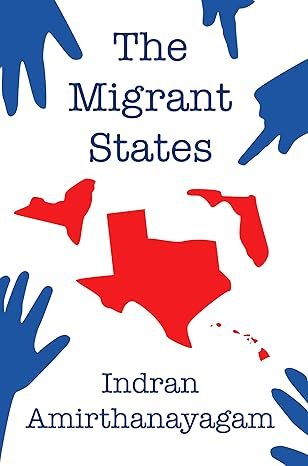
The Body Politic and the Body Poetic
It is a peculiar anxiety of our time, this feeling of living inside a contradiction we cannot name. We carry in our pockets devices of limitless connection while feeling profoundly isolated. We espouse ideals of global citizenship while retreating behind newly fortified walls, both national and psychological. The language of democracy, once a clarion call, now feels thin, co-opted, and “flat.” Into this spiritual exhaustion steps the poet, whose job has always been to reinvigorate the language—to take the “flat” word and make it sing, or, failing that, to make its flatness mean something new.
Few poets have taken on this contradiction more directly than Indran Amirthanayagam. In his collection The Migrant States, he wades directly into the central conflict of the 21st-century American experiment: the grand, inclusive promise of its “idea” versus the “toxic” reality of its politics. This is not just another book about immigration. It is an ambitious, sprawling, and deeply personal attempt to diagnose the “shifting states of mind” of a nation, and a self, in exile.
Amirthanayagam’s central project is an act of audacious, almost defiant, dialogue. The book is, from its first section, a direct address to Walt Whitman, the high priest of American democratic verse. But this is no simple homage. Amirthanayagam, a prolific polyglot poet born in Sri Lanka, approaches Whitman not as a supplicant but as a troubled heir, asking, in essence: What happens to your ‘brimming multitude’ when the nation decides it is full?
The collection is his answer. Amirthanayagam’s ambition is to “out-Whitman” Whitman, to stretch the American “embrace” beyond its national borders to encompass the entire continent, from the streets of Manhattan to the fringes of the Amazon. He argues that the true “America” is not a fixed nation-state but a perpetual condition of migration.
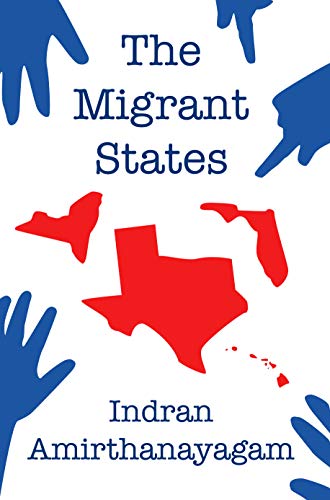
This is not Amirthanayagam’s first foray into the poetics of displacement—his oeuvre is built on it—but The Migrant States feels like a culmination. He is a poet in conversation with a global, humanist tradition, joining contemporaries who interrogate empire, memory, and language. Yet his primary formal allegiance here is purely American. The book’s aesthetic is built on Whitman’s “long, tumbling lines,” a free verse that rushes forward with the momentum of a catalog.
Where Whitman’s catalogs sought to contain a multitude, Amirthanayagam’s seek to connect one. His method is associative, digressive, and restless. He is, as one critic aptly noted, like a “Jesus bug… skimming an entire lake,” his poetics based on linking disparate surfaces rather than plumbing a single depth.
This style is a formal embodiment of the migrant’s mind, a consciousness that exists in multiple places at once. In “Morning Mass, Halloween (for Lola),” a poem that captures his method in miniature, the speaker observes a woman collapsing in a church pew. This image does not lead to a singular meditation on mortality; instead, it immediately splinters. The moment connects to the paramedics who arrive, which flashes to the speaker’s own father, who also died at a pew, which then refracts again to his daughter.
The poem “knits together” these disparate threads—the stranger, the father, the child—into a single, earned emotional fabric. The poem’s meaning is not in the image; it is in the connections between them. This is Amirthanayagam’s central thesis in action: empathy is not a static feeling but an active, associative process. His “world-encompassing voice” is not a political stance but a stylistic necessity.
He brings this same connective energy to the political. When he laments “President Trump’s anti-immigrant rhetoric,” he does so not with the shrillness of punditry but with the “mature, fully earned” sorrow of a believer betrayed. In “The Migrant’s Reply,” the collective “we” speaks:
“We have been running for so long. We are tired.
We don’t want to wake up tomorrow and pack
our bags. We have gone 10,000 miles…
What next? You are putting up
a wall on your Southern flank? What an irony.”
The lines are simple, almost prosaic. The “irony” is stated, not forced. And yet, the “melodic force” of the long, breathless lines gives the poem a gravity that more “lyrical” verse might miss.
In one of the collection’s most telling moments, Amirthanayagam includes a poem of self-critique: “I realize,” he writes, “my lines are not lyrical. / They have no surprising leaps, / or rhythmic epiphanies. They are flat…”
This is the poet hanging a lantern on his own greatest risk, and it provides the “turn” for any honest review of this book. Amirthanayagam’s expansive, plain-spoken style is a high-wire act. When it works, it feels like “exuberant optimism,” a generous “sigh of recognition.” But when it falters, the wire disappears.
The book’s primary weakness is that its associative method occasionally dilutes, rather than concentrates, its power. There are, scattered throughout, “odd, too-private, too hermetic” poems where the threads held by the poet are not passed to the reader. In these moments, the “skimming” risks becoming shallow, and the connections feel forced or opaque. The Whitman-esque catalog, in lesser hands, can become just a list. And when Amirthanayagam’s “flat” line loses its internal music, it does just lie flat on the page, a statement of fact rather than a vessel of feeling. This reliance on the reader’s “taste” makes the collection feel, at times, uneven.
But this critique feels small when weighed against the book’s successes. The “flatness” Amirthanayagam diagnoses is not a personal failure but a cultural one. He is writing about a world whose “epiphanies” are harder to come by. His project is to find the lyrical in the bureaucratic, the spiritual in the exhausted.
More often than not, he succeeds, especially when he “zooms in on precise details” that ground the expansive vision. He sketches an “impressionistic portrait of Manhattan” and finds “a tailor who survived the number / branded on his arm.” He celebrates Thanksgiving with an “abundant sense of humor” that feels defiant. These “arresting conclusions” anchor the sprawling, digressive lines and prove his own self-critique wrong.
So, why does this book matter now?
We began with the anxiety of contradiction. The Migrant States does not resolve it. Instead, it offers a way to inhabit it. Amirthanayagam’s poetic “project” is to insist that contradiction is the American condition. The “multitude” is, by its nature, contradictory.
His book serves as a necessary corrective to two opposing, and equally dangerous, literary trends: the hermetically-sealed lyric that refuses the “mess” of the world, and the purely political poem that sacrifices art for message. Amirthanayagam refuses this choice. His book is a testament to the idea that the “body politic” and the “body poetic” are one and the same.
He succeeds in his ambition. He has written a book that is, in the truest sense of the word, American—not by celebrating its myths, but by cataloging its complex, often-painful realities with a “sanguine but trustworthy” voice. The Migrant States does not just “speak to” our cultural moment; it provides a formal and emotional grammar for it. It reminds us that to be a “migrant” is not just to move between countries, but to be a thinking, feeling human, moving constantly between the “shifting states” of memory, grief, and a stubborn, exuberant hope.
-
How to read poetry: 4 Exercises
To truly engage with poetry, it is essential to understand its foundational elements. Poetry, at its core, is a form of literary expression that utilizes concise language and rhythm to evoke emotions and imagery. Familiarizing oneself with key components such as meter, rhyme, imagery, and themes can significantly enhance one’s reading experience. Meter in poetry…
-
Lists | Poetic Forms | Poetry
Poetic Forms #1 Ars Poetica
An ars poetica poem is a poem examining the role of poets themselves as subjects, their relationships to the poem, and the act of writing. Among the first known treatises on poetry, Horace’s “Ars Poetica” (also referred to as Letters to Piso) is literally translated as “The Art of Poetry” or “On the Art of Poetry.” Composed…
-
2026 | Books & Literature | Lists | Poetry
The Best Poetry Books of 2026 for Healing and Self-Discovery
Looking for the best poetry books of 2026? From Elise M. Powers to Maggie Smith, discover modern poetry for beginners focused on healing and self-discovery.
-
Crafting the Perfect Title: The Art of Poetic Naming
The Significance of a Poetic Title The title of a poem serves as the first point of interaction between the reader and the text, wielding significant influence over the audience’s initial impressions and engagement. A well-crafted title can encapsulate the essence of the poem, providing a glimpse into the thematic core and emotional landscape within…
-
The Telaraña Circuit by Lucía Hinojosa Gaxiola
We are living in an age of total recall and digital amnesia. Our lives are meticulously documented, our every gesture captured, tagged, and stored in a server cloud. Yet this relentless accumulation of data has done little to satisfy our hunger for memory. In fact, it may have exacerbated the crisis. The digital archive is…
-